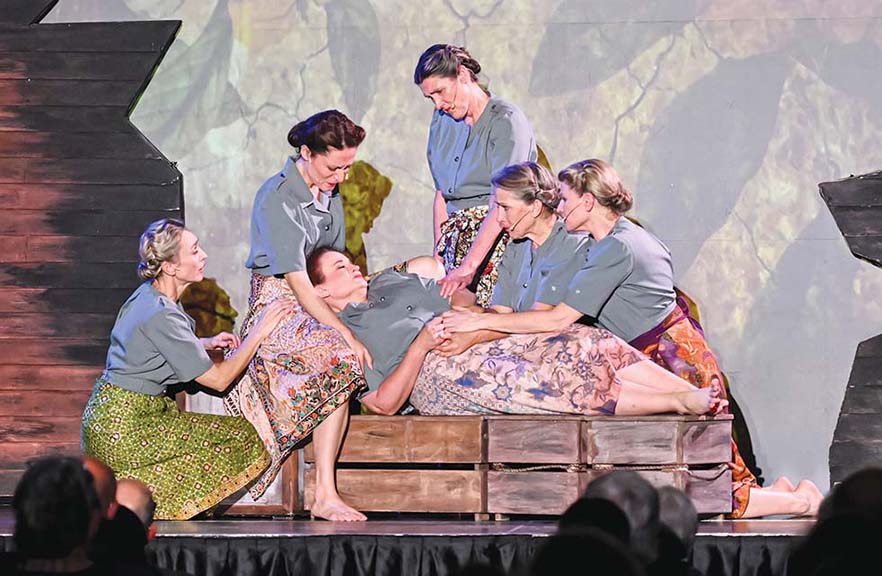
On Saturday 7th June just over 200 people from around the district attended the sold-out live performance in the Bridgetown Town Hall of ‘21 Hearts’, a theatrical show which tells the story of Vivian Bullwinkel and the nurses on the SS Vyner Brook.
In some regards that audience was privileged, this show has performed to sold out audiences since its world premiere season opened in the Como Theatre during April 2024.
An absolute pinnacle for the show is that ‘21 Hearts’ has now been selected to be showcased as a Flagship Event in the newly massively refurbished Australian War Memorial in Canberra during the 80th anniversary commemorations of the end of World War II.
21 Hearts will be performed throughout the months of July and August in the War Memorial Theatre, also newly refurbished.
The show pays tribute to the compelling and heart wrenching story of the Australian nurses who were ordered to evacuate Singapore. The story is centred around Vivian Bullwinkel and 65 Australian Army nurses who boarded the Red Cross flagged ship SS Vyner Brooke, a British cargo vessel designed to carry 12 passengers.
Of those on board the ship; 12 nurses were killed during the air attack or drowned following the ships sinking, 21 were murdered on Radji Beach and 32 became prisoners, eight of whom subsequently died before the end of the war.
At its heart is a gripping, true story that commemorates and celebrates women’s strength, loyalty and fortitude in the face of adversity.
The play is produced by THEATRE 180; Rebecca Davis is the Executive Theatre Director and has the role of Vivian Bullwinkel; she explains how this extraordinary story has come to the stage, “Stuart Halusz and myself had the great privilege of interviewing Vivian Bullwinkel some thirty years ago in 1995 as we worked for Agelink Theatre.
“Agelink Theatre Company was established by Jenny Davis, my mother, with its core ideal being based on gathering and performing oral history stories.
“To meet with Vivian and to hear her story for the first time was so impactful on me, Stuart and I turned to each other afterwards and we said, we have to take this story to the stage, we have to tell this story, but we were not sure when the right time was, but we often talked about doing it.
“It wasn’t until, some thirty years later, we were performing ‘A.B. Facey’s A Fortunate Life’ in Wickepin in 2021, when after the show a lady came up to us, Libby Heffernan, who is on the Facey Homestead Committee, and asked us we ever thought of doing a play on Vivian and the nurses as her sister Anthea Hodgson, was writing a book about the nurses, their Great Aunt Minnie Hodgson was killed on Radji Beach.
“It seemed incredible timing. On doing some research I also discovered, in actual fact, there were two or three other books being published about the nurses as well, so I’m thinking there’s something in the zeitgeist.
“The company applied for a government grant to do some creative development on the show, again we were not sure what style of theatre it would take, we wanted a big strong cast of women naturally, but we were unsure if it would be in this genre or not, the genre which you will see tonight, a live performance in front of a cinematic display.
“Then during the development, we got in contact with the Australian College of Nursing who were in the middle of a fundraising campaign to raise funds to create a statue of Vivian.”
This sculpture in Vivian’s honour now stands at the Australian War Memorial, a poignant reminder of her bravery and the sacrifices of those who served alongside her. Her statue stands opposite that of Sir Edward ‘Weary’ Dunlop, reminding us of the enduring legacy of their courageous service, defying the odds whilst giving hope to others.
Rebecca continues, “So, we thought, the stars are aligning here, so we needed to do something with the story.
“So, this is when Jenny Davis wrote the script, a truly wonderful play script which handles the story so respectfully.
“In the show we don’t shy away from the horrors which were inflicted on the nurses or on the life they had to endure in the prison camp.
“Jenny’s writing allows you to feel the horror, and feel the impact of its effects without seeing the horror.”
The story is a mix of initial adventure and comradery of the nurses before the reality of war sets in, having to evacuate Singapore, their ship being attacked and then sunk, with the survivors then having to swim to relative safety on Radji Beach.
In one of the most atrocious acts of war crimes in our history, 22 nurses were forced to march into the sea where they were callously machine gunned.
This is when one of the most memorable scenes takes place, the one which lives in Australian folklore. The nurses knowing their fate, all join hands gaining collective courage from each other, with their matron asking the women to be quietly brave as they walk into the ocean as one, before being machined gunned down.
The only survivor and witness, Vivian Bullwinkel spent the rest of the war in a prison camp, in and around Sumatra for three and a half years, secretly vowing to herself to stay alive long enough to tell of the war crime committed against the nurses on Radji Beach.
Life in the prison camp for the nurses was not easy, but as women do, they gather strength and support from one another, finding support and comfort through companionship, a camp choir, playing games and most of all caring for one and another.
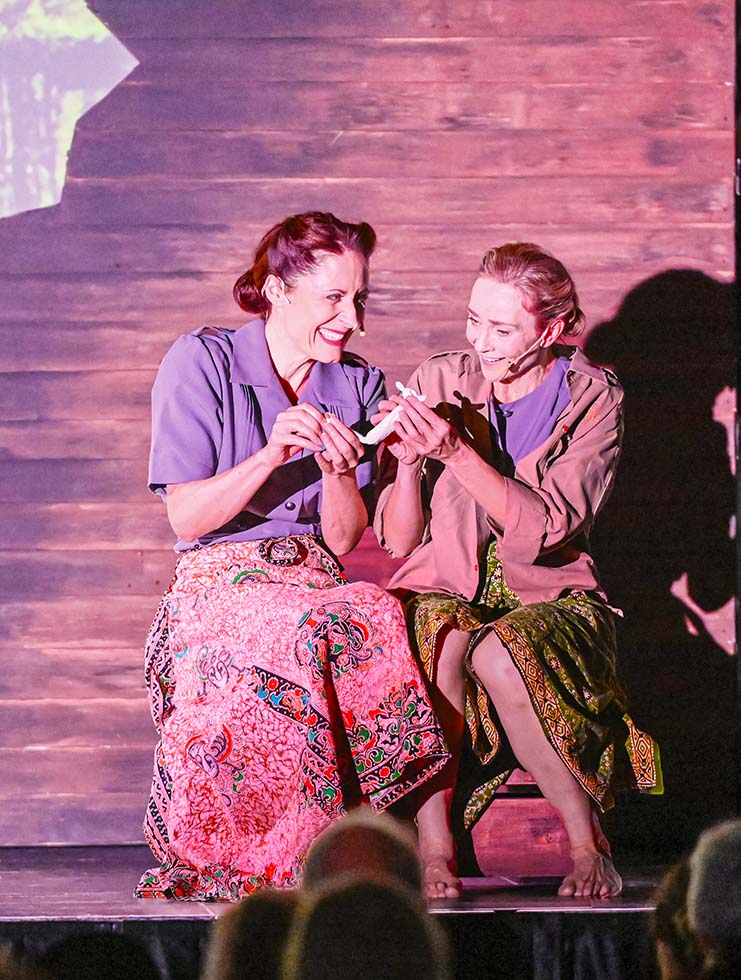
Vivian formed a lifelong friendship with fellow prisoner Edie, a young thirteen-year-old girl when they first met. Asked for her name, Edie responded with ‘Bet’: a name she believed sounded strong. Vivian called her ‘Little Bet’.
Little Bet held on dearly to a couple of her important possessions; a handkerchief her brother gave her and a gold bangle that once belonged to her mother. She covered the bangle in mud to cheapen its appearance to that of a worthless token. When Vivian became seriously ill with dysentery, Little Bet traded the now shiny bangle for limes which were needed to save Vivian’s life.
The announcement of the end of the war was met with shocked silence in the camp. On 18 September 1945, the prisoners were flown to Singapore, the malnourished women in the prison camps needed to be ‘fattened up’ before returning to Australia. Vivian was then ordered to go to Tokyo and testify at the War Crimes Commission and tell the tale of one of the most atrocious acts of war crimes in Australia’s history that was committed on her friends and colleagues, to speak of their bravery, their strength, and courage in the face of death.
In November 1947, Betty Jeffrey and Vivian Bullwinkel set out to promote a fundraising appeal for the establishment of a War Nurses’ Memorial Centre in Melbourne. They visited every hospital in Victoria with more than 20 beds to present their vision of an educational and social centre for the nursing profession that would also function as a living memorial to their fallen colleagues.
Betty Jeffrey and Vivian Bullwinkel together with Edith Hughes-Jones, Wilma Oram and Annie Sage, fellow survivors, were the founding members of this legacy which still proudly offers scholarships for nurses and midwives as part of its mission to act as a living memorial by advancing the nursing profession through education.
“The biggest honour I have had in my acting career is the role I play as Vivian Bullwinkel; it sits above and beyond all the roles I have acted, it affects us all on a deep level, it’s hard not to be, I feel honoured to tell her story every night we perform the show,” Rebecca Davis.
The stage production of ‘21 Hearts’, features an all-female cast of six of Western Australia’s outstanding actors, gives a respectful and authentic voice to those who were silenced, remembers them for who they were and not just for what happened to them. A story of hope, courage, resilience and heart, and if you get the chance, it’s a show you must see and a tale you should retell.
This Story was published on July 1st 2025
In Issue 355 of The Mailbag
© The Quality Shop 125 Hampton Street Bridgetown Western Australia 6255
mailbag@thequalityshop.com.au